Introduction and Historical Development:
Nestled in Bhutan’s pristine Bumthang Valley lies Kurjey Lhakhang or the Kurjey Monastery Complex – a stunning piece of Bhutanese architecture that is steeped in a thousand years of mythical tradition. Named after the body (kur) print (jey) of Guru Rinpoche or Padmasambhava the complex is constructed into the side of a hill and consists of three separate temples impressively surrounded by 108 separate chortens or stupas.1
1 “Kurjey Lhakhang,” Lonely Planet, accessed August 24, 2023, https://www.lonelyplanet.com/bhutan/chokhor-valley-bumthang/attractions/kurjey-lhakhang/a/poisig/ 1371075/1335542; “Kurje Lhakhang,” Breathe Bhutan, accessed August 24. 2023, https://www.breathebhutan.com/attractions/kurje-lhakhang/.
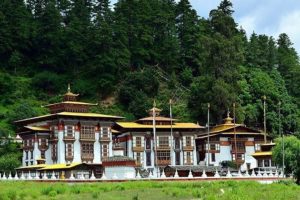
The first and holiest of these temples, Guru Lhakhang, was constructed in 1652 by Mingyur Tenpa, the penlop or governor of Trongsa, before he became Bhutan’s third Desi.2 It consists of two floors with the lower floor, Sangay Lhakhang, housing a small crawl-through rock passage which according to legend has the power to wipe away the sins of any who crawl through it. While the upper floor, the temple’s main attraction and holiest place, holds a thousand small statues of Padmasambhava, Pema Lingpa, and Drolma, it more importantly also houses the entrance to a meditation cave that is said to be the home to a bodyprint produced by Padmasambhava himself in the 8th century. Along those lines, a large cypress tree can also be found outside the temple which is said to have sprouted directly from Padmasambhava’s staff all those centuries ago.3
2 “Bumthang Attractions Kurjey Lhakhang,” Go Bhutan Tours, accessed August 24, 2023, https://www.gobhutantours.com/kurjey-lhakhang/.
3 “Kurjey Lhakhang,” Lonely Planet, accessed August 24, 2023, https://www.lonelyplanet.com/bhutan/chokhor-valley-bumthang/attractions/kurjey-lhakhang/a/poisig/ 1371075/1335542; “Kurje Lhakhang,” Breathe Bhutan, accessed August 24. 2023, https://www.breathebhutan.com/attractions/kurje-lhakhang/.
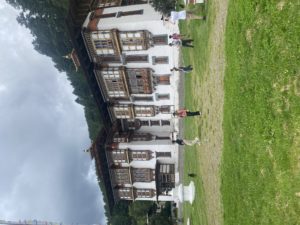
The second temple, Sampa Lhundrup Lhakhang, meanwhile was constructed in 1900 by the first king of Bhutan, Ugyen Wangchuck, while he was still penlop of Trongsa. This multi-storied temple houses an absolutely massive ten-meter-high statue of Padmasambhava, flanked by eight smaller statues depicting his eight manifestations. While a smaller statue of Padmasambhava sitting and facing Tibet with a defiant stare, a nod to the complicated and often violent history between the two regions, can also be found inside.4
4 “Kurjey Lhakhang,” Lonely Planet, accessed August 24, 2023, https://www.lonelyplanet.com/bhutan/chokhor-valley-bumthang/attractions/kurjey-lhakhang/a/poisig/ 1371075/1335542; “Kurje Lhakhang,” Breathe Bhutan, accessed August 24. 2023, https://www.breathebhutan.com/attractions/kurje-lhakhang/.
Finally the third and newest temple, Ka Gon Phur Sum, which translates to the ‘Three Mystic Revelations of The Eight Pronouncements’ was constructed in 1984 by Ashi Kesang Wangchuck, the wife of the third king, with the assistance of Dilgo Khyentse Rinpoche.5 The Queen also was responsible for the construction of the 108 chortens that occupy the monastery’s grounds during this same time. The chortens also known as Jangchub Chortens symbolize both the Buddha’s victory over evil and the righteousness of his claim to enlightenment while simultaneously working to transform the complex into a massive three-dimensional mandala in the same manner as the Samye Monastery in Tibet.6
5 “Kurjey Lhakhang in Bhutan,” Bhutan Holidays, accessed August 24, 2023, https://bhutanholidays.net/kurjey-lhakhang.
6 “Kurjey Lhakhang,” Lonely Planet, accessed August 24, 2023, https://www.lonelyplanet.com/bhutan/chokhor-valley-bumthang/attractions/kurjey-lhakhang/a/poisig/ 1371075/1335542; “Kurje Lhakhang,” Breathe Bhutan, accessed August 24. 2023, https://www.breathebhutan.com/attractions/kurje-lhakhang/.
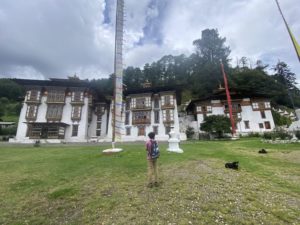
Finally, in addition to housing the three temples and many chortens that comprise the complex, Kurjey Lhakhang also serves as the final resting place for Bhutan’s first three kings. A fact that only adds to the location’s already revered status as one of modern Bhutan’s most sacred pilgrimage sites.7
7 “Kurjey Lhakhang in Bhutan,” Bhutan Holidays, accessed August 24, 2023, https://bhutanholidays.net/kurjey-lhakhang.
Mythical Background:
While the first temple at Kurjey Lhakhang may have been built in 1652 the mythical origins of the site can be traced back all the way back to the 8th century to a time before the kingdom of Bhutan as we know it today even existed. Before modern Bhutan was founded in 1616 by Zhabdrung Ngawang Namgyal, Bhutan was a land ruled by various petty kings.8 One of which was Sendha Gyab, an Indian, who in the 8th century conquered Bumthang where he took the name Sindhu Raja. However, it is said that while at war with a neighboring monarch named Naochhe or ‘Big Nose’, a king who ruled part of Southern Bhutan, Sindhu Raja’s beloved son was killed in battle, and in a fit of rage the king made the tragic mistake of desecrating the abode of Bumthang’s highest deity Shelging Kharpo. Greatly offended by the king’s actions, Shelging Kharpo is said to have filled the skies with darkness and stolen the King’s life force, very nearly bringing him to the brink of death.9
8 “History of Bhutan,” Heavenly Bhutan, accessed August 24, 2023, https://www.heavenlybhutan.com/gnh-bhutan-land-of-happiness/history-of-bhutan/.
9 “Kurjey Lhakhang Monastery of the Bodyprint,” Show Caves, accessed August 24, 2023, https://www.showcaves.com/english/other/subterranea/KurjeyLhakhang.html.
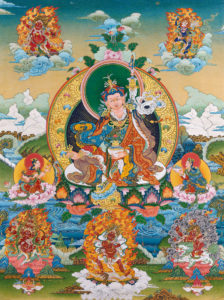
Thus in a desperate bid to save the King’s life, one of his secretaries invited Padmasambhava, an already highly revered saint known for his supernatural powers throughout the Himalayas, to Bhutan to save the king. Padmasambhava agreed and so in 746 CE he journeyed to Bhutan and Bumthang. Upon arriving legend tells us that Padmasambhava found a cave at the site of Kurjey Lhakhang and proceeded to meditate there; leaving an imprint of his body in the process. An imprint or ‘kurjey’ that has gone on to give Kurjey Lhakhang its name.10 Through this meditation, Padmasambhava is said to have identified the local deities including Shelging Kharpo as the sources of the king’s ailment and thus set out to subdue them.11
10“Kurjey Lhakhang Monastery of the Bodyprint,” Show Caves, accessed August 24, 2023, https://www.showcaves.com/english/other/subterranea/KurjeyLhakhang.html.
11 “Kurjey Lhakhang in Bhutan,” Bhutan Holidays, accessed August 24, 2023, https://bhutanholidays.net/kurjey-lhakhang.
With this goal in mind, we are told that Padmasambhava sent Sindhu Raja’s daughter, Princess Tashi Khuedon, to collect water with a golden ewer. Once she had departed legend says he transformed himself into all of his eight manifestations and began a ritual dance in an attempt to lure Shelging Kharpo and the other deities out of hiding so they could be subdued. The spectacle of the eight manifestations dancing quickly garnered the attention and presence of all the local deities except for Shelging Kharpo who stubbornly and smartly remained hidden. However, Padmasambhava had a backup plan and thus when Princess Tashi Khuedon returned Padmasambhava transformed her into five identical versions of herself each now equipped with a separate golden ewer. With five ewer’s now congregated in a single spot the sun’s rays produced a powerful reflection that even Shelging Kharpo could not ignore. Finally, this impressive reflection lured Shelging Kharpo out of hiding and he soon appeared to Padmasambhava in the form of a white snow lion.12
12 “Kurjey Lhakhang Monastery of the Bodyprint,” Show Caves, accessed August 24, 2023, https://www.showcaves.com/english/other/subterranea/KurjeyLhakhang.html.
Sensing his opportunity, Padmasambhava quickly transformed himself into a garuda,13 a divine bird-like creature with the body of a human and the wings and beak of a bird,14 and engaged Shelging Kharpo in intense combat where he quickly defeated him. Upon his victory, Padmasambhava is said to have commanded Shelging Kharpo to return Sindhu Raja his life force. However, legend says he did not stop there and the great Padmasambhava soon successfully convinced Shelging Kharpo to also become a Buddhist protective deity, a role which he fulfills to this day. It is then said they sealed this deal and Shelging Kharpo’s newfound role with Padmasubmbhava sticking his staff into the ground. And so with his life force returned the king’s health recovered, the staff would eventually grow into the aforementioned cypress tree, and Padmasambhava would go on to convert both Sindhu Raja and Naochhe to Buddhism and convince them to stop the warring that led to this whole debacle in the first place.15
13 “Kurjey Lhakhang Monastery of the Bodyprint,” Show Caves, accessed August 24, 2023, https://www.showcaves.com/english/other/subterranea/KurjeyLhakhang.html.
14 Joanna Tatomir, “Garuda, the Bird Demigod: Origin & Mythology I Who was Garuda,” accessed August 24, 2023, https://study.com/academy/lesson/garuda-bird-demigod-origin-mythology.html.
15 Kurjey Lhakhang Monastery of the Bodyprint,” Show Caves, accessed August 24, 2023, https://www.showcaves.com/english/other/subterranea/KurjeyLhakhang.html.
For many Bhutanese Padmasambhava’s subjugation of Shelging Kharpo at Kurjey Lhakhang and the successful conversion of Sindhu Raja and Naochhe are widely seen as marking the arrival of Buddhism in Bhutan – thus cementing Kurjey Lhakhang’s important place in Bhutanese lore in the process.16
16 “Bhutan: A Rich History,” PBS, accessed August 24, 2023, https://www.pbs.org/edens/bhutan/Bhu_people2.htm.
Kurjey Lhakhang Today:
Today, Kurjey Lhakhang continues to play a key role in Bhutanese Buddhist tradition serving as one of Bhutan’s most holy pilgrimage destinations. The temple of Guru Lhakhang, which houses the body print of Padmasambhava himself, continues to be the complex’s main attraction drawing devotees from across the region for prayer, meditation, and blessings. While the second temple, Sampa Lhundrup Lhakhang, and its massive ten-meter-high statue remains a shrine of great religious importance in its own right.17 Meanwhile, in addition to housing many significant religious sites, as the final resting place of Bhutan’s first three kings, the complex’s already revered status is only further enhanced. While Bhutan may no longer be the absolute monarchy it once was, the kings of Bhutan are still highly revered and beloved figures who draw widespread veneration and devotion from the people.18
17 “Kurjey Lhakhang,” Tour My India, accessed August 24, 2023, https://www.tourmyindia.com/international/bhutan/kurjey-lhakhang/.
18 “Kings of Bhutan,” Druk Asia, accessed August 24, 2023, https://www.drukasia.com/bhutan/kings-of-bhutan/.

One of the complex’s largest roles in modern Bhutanese society occurs every June/July, depending on the Bhutanese lunar calendar, with the Kurjey Tshechu festival. A popular annual festival dedicated to celebrating the deeds and teachings of Padmasambhava sees Kurjey Lhakhang fill with hundreds of spectators clamoring to witness traditional cham dances, live music, and the unfurling of a massive thongdrol thangka (scroll painting), which is said to wash away the sins of any who witness its reveal. The festival is an important part of Bhutanese spiritual tradition that believes that attending festivals provides good merit and brings the attendee closer to the end goal of enlightenment. But, the festival is also a time for locals to simply socialize, laugh, be entertained, and revel in the unique cultural traditions of their ancient kingdom.19 With riveting history, a fascinating mythical background, and exciting festivals, Kurjey Lhakhang remains a place like no other and a must-see on any visit to Bhutan.
19 “Things to Know about Tshechu Festival in Bhutan,’ India Odyssey Tours, accessed August 24, 2023, https://www.indiaodysseytours.com/knows/tshechu-festival-bhutan.html#:~:text=Tshechu%2C%20or%20t he%20Mask%20Dance,Bhutan%20in%20the%208th%20century.

Sources
“Bhutan: A Rich History.” PBS. accessed August 24, 2023. https://www.pbs.org/edens/bhutan/Bhu_people2.htm.
“Bumthang Attractions Kurjey Lhakhang.” Go Bhutan Tours. accessed August 24, 2023. https://www.gobhutantours.com/kurjey-lhakhang/.
“History of Bhutan.” Heavenly Bhutan. accessed August 24, 2023. https://www.heavenlybhutan.com/gnh-bhutan-land-of-happiness/history-of-bhutan/.
“Kings of Bhutan.” Druk Asia. accessed August 24, 2023. https://www.drukasia.com/bhutan/kings-of-bhutan/.
“Kurjey Lhakhang.” Lonely Planet. accessed August 24, 2023. https://www.lonelyplanet.com/bhutan/chokhor-valley-bumthang/attractions/kurjey-lhakhang/a/poisig/ 1371075/1335542
“Kurje Lhakhang.” Breathe Bhutan. accessed August 24, 2023. https://www.breathebhutan.com/attractions/kurje-lhakhang/.
“Kurjey Lhakhang in Bhutan.” Bhutan Holidays. accessed August 24, 2023. https://bhutanholidays.net/kurjey-lhakhang.
“Kurjey Lhakhang Monastery of the Bodyprint.” Show Caves. accessed August 24, 2023. https://www.showcaves.com/english/other/subterranea/KurjeyLhakhang.html.
“Kurjey Lhakhang.” Tour My India. accessed August 24, 2023. https://www.tourmyindia.com/international/bhutan/kurjey-lhakhang/.
Tatomir, Joanna. “Garuda, the Bird Demigod: Origin & Mythology I Who was Garuda.” accessed August 24, 2023. https://study.com/academy/lesson/garuda-bird-demigod-origin-mythology.html.
“Things to Know about Tshechu Festival in Bhutan.’ India Odyssey Tours. accessed August 24, 2023. https://www.indiaodysseytours.com/knows/tshechu-festival-bhutan.html#:~:text=Tshechu%2C% 20or%20the%20Mask%20Dance,Bhutan%20in%20the%208th%20century